

ADVERTISEMENT:
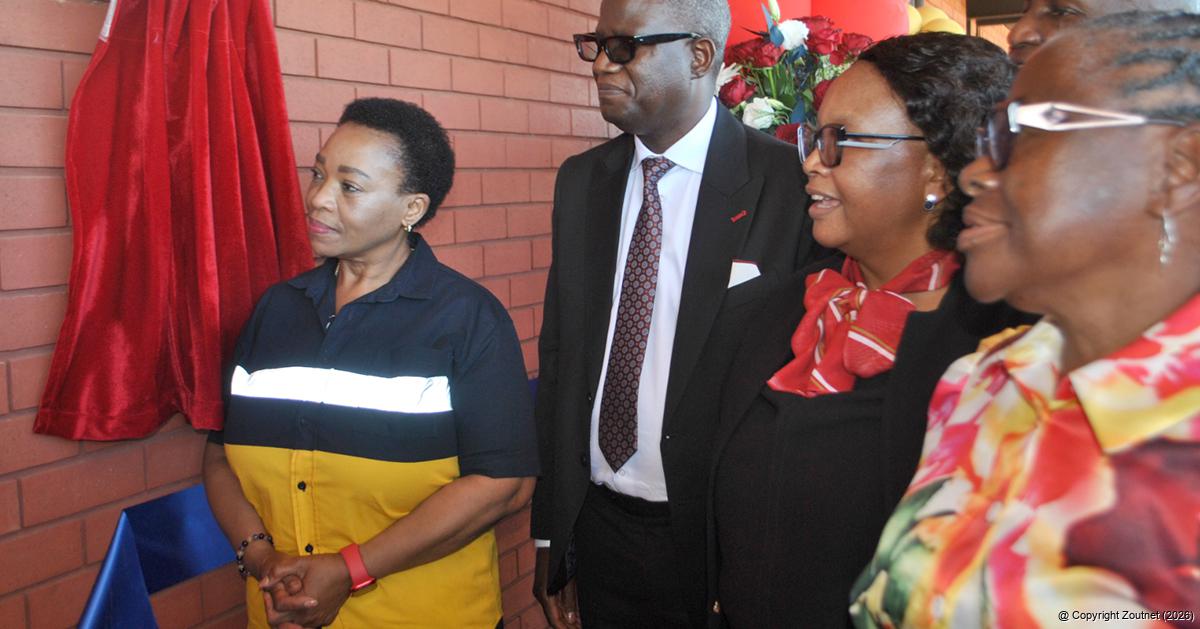
Deputy Minister of Higher Education Dr Nomusa Dube-Ncube (in the front), unveils the nursing science buildings at Univen, while Univen Vice-Chancellor and Principal Prof Bernard Nthambeleni and some dignitaries look on. Photo: Silas Nduvheni.
Univen unveils infrastructure projects of R600 million
News Date: 13 December 2025
The University of Venda has opened four major infrastructure projects worth more than R600 million, delivering new teaching, research and access facilities aimed at strengthening higher education in rural Limpopo.
The projects were officially opened on campus on Friday by Deputy Minister of Higher Education and Training Dr Nomusa Dube-Ncube, who was joined by Limpopo MEC for Public Works, Roads and Infrastructure Ernest Rachoene, Vhembe District Municipality executive mayor Freda Nkondo and Univen vice-chancellor Prof Bernard Nthambeleni.
The four completed projects are the Faculty of Health Sciences Building, the Punda Maria Road and Bridge, an upgraded Main Administration Building and an Advanced Nursing Science Simulation Building.
Dr Dube-Ncube said Univen had been allocated R1.367 billion over six cycles of the Infrastructure and Efficiency Grant (IEG) of the South African Government. She said the university had also benefited significantly from the Sibusiso Bengu Development Programme, which she described as the single largest capacity-development intervention by the government, dedicated to the future development and empowerment of historically disadvantaged universities.
The Punda Maria Road and Bridge Project, valued at R174 million and funded through the IEG, provides a safe and efficient connection between Thohoyandou town centre and the Univen campus. The 32-metre cable-stayed bridge and gatehouse stand as architectural landmarks, reinforcing Univen's vision of a smart, accessible and future-ready campus.
The Faculty of Health Sciences Building cost R220 million and was funded through the IEG. It houses four health-sciences disciplines - public health, nutrition, biokinetics and environmental health - under one roof. The building features cutting-edge laboratories, research spaces and student learning areas designed to foster interdisciplinary collaboration and innovation.
The Main Administration Building alterations and additions cost R168 million and were funded by Univen. The refurbishment included fully integrated electrical, electronic and mechanical systems.
The Advanced Nursing Science Simulation Building cost R71 million and was funded through the Sibusiso Bengu Development Programme. It features advanced simulation laboratories that mirror real clinical environments, immersive digital classrooms and high-fidelity training equipment.
The projects align with the Department of Higher Education and Training's Macro-Infrastructure Framework, the National Development Plan 2030 and Univen's Vision 2040. They aim to strengthen academic excellence and support rural development in the Thulamela and Vhembe communities.
Dr Dube-Ncube said it was important that, when new facilities were built, life-cycle costs were taken into account. She said Univen must ensure its infrastructure was properly and regularly maintained.
Prof Nthambeleni said the journey of undertaking infrastructure projects of this magnitude was often fraught with challenges, but these difficulties highlighted the importance of strong management and teamwork.
"Despite facing several construction-related challenges, such as fluctuating material costs, contractors' poor performance, environmental hurdles related to wetland areas, which required redesigns and securing extra environmental approvals and internal in-house project management skills gap, they have remained focused on our goals and dedication to seeing these projects through to completion. This launch represents a significant milestone in the University of Venda's journey. It is a moment of hope and anticipation. A moment to reflect on our steadfast dedication to delivering an outstanding educational experience for our students," said Prof Nthambeleni.
The university said the new infrastructure would expand capacity in health sciences, improve access and mobility on campus and strengthen teaching, research and student support in one of Limpopo's most rural higher-education institutions.
Written by
Silas Nduvheni

ADVERTISEMENT: